We had our last regular monthly meeting on Thursday 28th August, 2014. We believe that the day and the time of our monthly meetings is no longer suitable and has led to few people being able to attend. We have decided to continue to meet on an informal basis to socialise and to discuss writing and future projects.
Our group has been united by email and we will continue to correspond and share news and information via the email. However we will also look forward to catching up for the informal meetings in future.
We continue to invite new members to join our community of writers. You can participate via email or if you would like to meet with us in person then that will give us an excellent opportunity to have one of our proposed informal meetings.
Friday, 29 August 2014


Sunday, 30 December 2012
UPDATE ON OUR GROUP'S ACTIVITIES
2013 is just around the corner which means that our writers’
group has been in existence for almost 8 years.
The membership has changed during this time as people come
and go but we have continued to have our monthly meetings.
As well as our monthly meetings and non-compulsory writing
assignments, our group has taken on a couple of projects which have been
completed successfully.
Below is a brief summary of what we achieved and, although I
will mention just a couple of names, I must point out that our projects would
not have come to fruition without the support and hard work of all our members
who happily volunteered their time, energy and creativity.
2011,
with a small grant from the Clifton Shire Council (now amalgamated into the
super-council that is Toowoomba Regional Council), we produced an audio CD
which features works from a number of our writers.
This project would not have seen the light of day if it hadn’t
been for the hard work and dedication shown by Dave Wellings
who arranged for the recording of the poems and short stories and he also found
volunteers to read the works.
17 things you must hear before CDs become obsolete ….
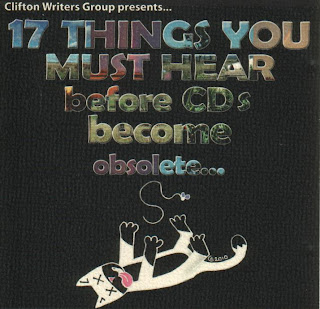 Kathleen Aisthorpe, a member with excellent graphic skills, was kind enough to create our CD cover.

17 things you must hear before CDs become obsolete ….


This CD is available to purchase ($5 AU plus postage) and if
you would like a copy then please contact us via our email address:
2012
saw the group take on a rather ambitious project with the help of a $500 grant
from the University of Southern Queensland, Toowoomba Qld.
The grant was for a community project and we decided to
write a play and produce it in the local hall during a major community event in
Clifton called the Clifton Country Week which occurs each October.
The community was asked to become involved by volunteering to
act or help out in the staging of the play.
We had 2 performances which were well attended and charged $5 for adults
to help cover costs and profits were to be distributed to a local charity.
Again we relied on Dave Wellings to spearhead
the project. Not only did he write the
play called “Watts Mine is Mine”, he also took on the
unenviable role of producer.
After much persuasion we were able to find some wonderful actors who were most generous with their time and patience.
We also had some very talented musicians from the area “The Barefoot Orchestra” to donate their time to entertain the crowd.
We were very fortunate to have the great skills of our local cartoonist and artist Al Benge who created 3 excellent scenes to use for the background of the play.


Again we would lik to thank Kathleen Aisthorpe for producing the above programme for us.
2013 will see our group busy putting on yet another play for the community. Again Dave Wellings has been busy writing the play and we were assured by our talented volunteer actors that they would love to become involved in any new play we were to produce.
I shall be back to report on our progress. Michelle.
Thursday, 1 September 2011
WE ARE ALIVE AND WELL JUST CONTACT US
Although this Blog has not been updated on a regular basis, it does not mean that our writers' group has ceased to be.
We meet each month at the meeting rooms of the Clifton Library and Community Centre which is something we have done since the founding of the group in 2005.
The aim of our group is to support local writers, to pass on relevant information, to offer helpful criticism when requested and to inspire each other to keep writing.
Our monthly assignment topics have produced some wonderful works. We try to add a brief and enjoyable writing exercise during the meetings and the results are very surprising and often amusing.
One of the positive outcomes of having this Blog drifting about in cyberspace has been the number of people who have contacted me for further information about the group.
I believe the reasons our group has endured are twofold.
Firstly, we charge no fees and it is not compulsory to participate in the written assignments.
Secondly, we use email to communicate to members who are unable to attend meetings. Written works and news are sent on to all members via the Internet.
Recently we have set projects for the group.
In October 2011 we will launch our audio book with stories and poetry.
In October 2012 we will produce a play, written by our members, with the help of volunteers and using the local hall. Any profits from the entry fee will be donated to local charities.
I will return with more information about both of these projects.
Thursday, 30 September 2010
TENTERFIELD WRITERS INK VISITS US
The Clifton Writers' Group meets once a month in the Clifton Library and Community Centre meeting rooms to discuss and practice the art of writing and also to support and inspire one another.
On Saturday 28th August, 2010, members from the Clifton Writers' group were very pleased to be able to host a get together with members from the Tenterfield Writers' Ink.
Below is a photograph of some of the members from the two groups in the Art Gallery of the Clifton Library.

This exciting opportunity arose when Drew Grozier (Clifton Writers' Group member) was in Tenterfield launching his book "Scotch on the Bitumen".
He met with members from the Tenterfield Writers' Ink and it was decided that the two groups should arrange a get together.
It took some months and quite a few emails back and forth before finding a suitable date.
Below are photographs showing the writers enjoying morning tea in the story reading area.


On arrival the writers had an informal morning tea in the sunny story reading area which gave them a chance to get to know one another.
The group then moved to the meeting room to begin the serious business of the day, that is, talk about the joys and tribulations of writing.
Lunch was held in the meeting room whilst examples of the writers' work were read aloud to the group.
It was a most successful day and firm friendships where forged.
There is a plan to meet again in Autumn 2011 but this time in Tenterfield where the changing colours of its glorious trees will surely inspire the writers and photographers within the group.
On Saturday 28th August, 2010, members from the Clifton Writers' group were very pleased to be able to host a get together with members from the Tenterfield Writers' Ink.
Below is a photograph of some of the members from the two groups in the Art Gallery of the Clifton Library.

This exciting opportunity arose when Drew Grozier (Clifton Writers' Group member) was in Tenterfield launching his book "Scotch on the Bitumen".
He met with members from the Tenterfield Writers' Ink and it was decided that the two groups should arrange a get together.
It took some months and quite a few emails back and forth before finding a suitable date.
Below are photographs showing the writers enjoying morning tea in the story reading area.
On arrival the writers had an informal morning tea in the sunny story reading area which gave them a chance to get to know one another.
The group then moved to the meeting room to begin the serious business of the day, that is, talk about the joys and tribulations of writing.
Lunch was held in the meeting room whilst examples of the writers' work were read aloud to the group.
It was a most successful day and firm friendships where forged.
There is a plan to meet again in Autumn 2011 but this time in Tenterfield where the changing colours of its glorious trees will surely inspire the writers and photographers within the group.
Sunday, 31 January 2010
WELCOME TO THE CLIFTON WRITERS' GROUP BLOG
Our group meets once a month and we encourage members to write through setting monthly assignments and also setting interesting writing exercises during the monthly meetings.
This blog site will feature some of the works from the members and we will also announce any news about our group.
If you wish to access further examples from our very talented writers then you can click on their names in the Links section on the right side of this page.
Some of our writers have published works and details about these books can be found on their blogpages.
Please feel free to comment.
Sunday, 7 October 2007
A DEAD LIBERTY by Dave Wellings
(The September assignment was to write a legend.)
Most successful entrepreneurs have a sense of opportunism that borders on cheek. In the late 1860s the construction of a railway line between Toowoomba and Warwick offered numerous opportunities. In addition to the vital transport for a growing sheep industry, the line brought with it a large work force which had to be catered for. Hastily built stores and unlicensed bars were established at every halt along the line. When the line reached the Clifton sheep station, an Irishman, James Mowen, built a slab hut from which he sold provisions and liquor to the railway “navvies”.
Seeing an opportunity in the expanding settlement, he decided to invest in Clifton. In 1869 he applied for and was granted a liquor licence and he built a hotel next to his store. A small plaque (appropriately across the road from O’Shanley’s Irish Bar) still marks the site of his original ‘Redbank Hotel’.
In response to increasing demand by migrants from overseas and the southern States, the government released parcels of Crown land across the Darling Downs and Mowen was quick to purchase a block in what is now the main street. He built the Clifton Arms Hotel and four other business premises, all of which he rented out. Such enterprise marked him out as an obvious person to approach when funds were required to build a Catholic church. He was appointed as joint-treasurer of the fund-raising committee and donated an acre of prime town land to the project. A small church was subsequently built near to the site of the present Catholic church.
He was a wealthy man when he died on 20th April 1897, at the time 600 pounds was a considerable sum of money and there were no heirs to inherit it. He had stipulated in his will that the money should be spent on a “grand monument” to be built over his grave. The executor of his will, John Logan, was an old friend and coincidentally a prime mover in fund-raising to build a new, larger church. The prospering Clifton township had long overgrown the original small church and John Logan was not slow to see the serendipity of his situation.
“When considering what form the memorial should take, it occurred to me that nothing would be more appropriate than a memorial church…”
Special dispensation was granted to have Mowen’s body exhumed from the Clifton cemetery and reburied at Meara Place and the present church was built over his grave – a grand monument, as he’d requested.
His name is immortalised in Mowen Street at the southern end of the main street which he had largely established – and in a more subtle way in the name of the church itself. James Mowen and John Logan may have fallen some way short of sainthood but when the fine new building was commissioned as the “Church of Saint James and Saint John” it was in recognition of their contribution.
It was a final touch of opportunism bordering on cheek and Mowen would have surely approved.
Dave Wellings ©
FORGET-ME-NOTS by Dave Wellings
(August's assignment was set by Gloria who selected an opening sentence onto which we must add our own 500 or so words to create a work of either fiction or non-fiction. The opening sentence reads:
"The lot of us met on Saturday afternoon as arranged.")
The lot of us met on Saturday afternoon as arranged. The regulars, the ones who cared enough to bring a bunch of flowers.
“Nothing flashy,” The Colonel had insisted, “We don’t want to attract the wrong kind of attention.” In The Colonel’s mind there was more stigma attached to flashiness than to sexually-transmitted disease, He wasn’t actually a colonel: he’d been pensioned off from the army with the rank of captain but he did little to discourage the use of his nickname.
Jason’s bouquet was what The Colonel probably had in mind – large showy red tulips which clashed with his maroon and gold scarf. It was windy up on the hillside overlooking the town but a football scarf and beanie looked out of place at a graveside. Jason was on his way to a match and was too young and gauche to consider such things.
Norman wore a beige cardigan under his navy blazer and he raised his brown trilby hat in respect as he placed his tasteful violas on the grave.
“It was her greatest fear, that she would be forgotten, that her life had meant nothing more than a few moments of gratification to those of us in need.”
“It was more than that,” said Graham who, like most of us, was on the wrong side of middle-age. “It was a useful life; she was a caring woman, a compassionate woman.”
“And a good listener,” added Ted who had missed having anyone to listen to him since his wife had died five years earlier.
Jason looked up, puzzled perhaps at the revelation. “I never…Some of us…It’s not always…I never know what to say to girls. She gave me my first – experience.”
We all nodded; we had our own reasons for knowing her and out reasons for regretting her passing, quite suddenly, a brain tumour, twelve months to the day.
With his need for military order, The Colonel arranged the flowers, tall tulips at the rear and the others in descending order of size to form one poignant tribute. The he stepped back, stood briefly to attention and spoke for us all: “Gone – but not forgotten.”
Dave Wellings ©
Tuesday, 25 September 2007
THE DISPARATE GROUP by Gloria Moress
(August's assignment was set by Gloria who selected an opening sentence onto which we must add our own 500 or so words to create a work of either fiction or non-fiction. The opening sentence reads:
"The lot of us met on Saturday afternoon as arranged.")
The lot of us met on Saturday afternoon as arranged. The pub was dim, the conditioned air sharp with the tang of stale beer. It was a little awkward until we’d downed the first round of drinks, then little knots of conversation tied us more firmly together. Besides our reason for meeting, we had nothing in common, so feelers were put out to establish some connection, to soften the business of the meeting with token familiarity.
I looked around at the disparate group with an inward smile. What had I expected – them all to be archetypal nerds, like me? My eyes lingered on a gorgeous woman, too curvy for current tastes, her full hips and breasts somehow perfectly in synch with her pouty lips, as if she could not quite close her mouth properly. Very sexy.
She was chatting with a fortyish, innocuous looking man. In his “casual” chinos and Ralph Lauren polo shirt, he looked pale and soft, probably from hours behind the desk telling others what to do. He cleared his throat several times, and looked at his feet self-consciously. What a place to try to pick up. Oh well, if you got lucky, at least you’d know what to expect later. A skinny girl with dreadful acne on her chin and neck hovered at the edge of the group. She was swathed in black layers, with pants that drain piped her thighs but bagged around her ankles. I’d never liked that look, and the pigeon toed, shuffling walk that went with it. I always think the person is in imminent danger of tripping over.
A solid, shorthaired woman in her mid thirties with a slightly impatient air was standing near an anxious looking younger man in jeans. She gave a cursory nod then looked away whenever he spoke to her. I’ve heard that looking past people when talking to them means you want to be somewhere else. Well, no one dragged her here. The young man was quite ordinary except for his stance; hunched with hands jammed in pockets so hard it’s a wonder he hadn’t torn the bottoms out.
And there was me. When I’d put the notice in the community pages of the paper, I was only half serious. I didn’t think any one would come forward, and here were six of us. I squared my shoulders and cleared my throat loudly to call the meeting to order. The others slid into their seats while I stood at the head of the table.
“Welcome to the inaugural meeting of TA,” I began. “Perhaps we could start with introductions, a brief history of your problem, and what you have tried so far to control it.” I took my place and glanced around enquiringly.
The businessman took the cue, “I’m Stephen. I’ve been doing it forever. It only really became a problem when I moved into my current position, which is quite high-pressure. Before that I could control it.” He took a breath. “I’ve tried all the usual methods to stop, even hypnosis, but I can’t. That’s why I’m here.”
The impatient woman stood. “I’m Anne. I’m a nurse and you’d think that in itself would stop me doing it. So far, nothing has worked, even the rubber band on the wrist to sting myself whenever I want it. I hope coming here isn’t another waste of time.” She sat abruptly.
Mr Average with the pocket problem spoke up. “I’m Tony. I’ve tried all sorts of things, from cognitive-behavioural therapy,” this occasioned a few interested murmurs, “to chemicals. I always find a way to do it, even though I hate myself for it. This is my last hope”
“I’m Jen,” the Bombshell. “I know this sounds bad, but I just really love doing it. No one worried much when I was younger, they just let me go, and now I’m not sure I can stop. Or even if I want to. But I’m getting married next year and my fiancée says I can’t do it anymore.” Sympathetic looks all round.
“I’m Vanessa,” Girl in Black. “I do want to stop. I’ve got enough problems without this stupid habit. I feel like a freak.”
I stood, “Thank you, every one. I’m Evan, as most of you know. I didn’t really think anyone would come, but I’m really glad you all did. If we achieve nothing else, at least we know we’re not struggling with this alone.” I looked at each face – sullen, impassive, eager, dubious, thoughtful.
“I think I came out of the womb doing it, and I do it every chance I get. Like Jen, I enjoy it, but also, like the rest of you, it causes problems in my life. I too feel like a freak, Vanessa, and hate myself, like Tony.” I nodded at each of them. “I do it when I’m stressed, when I’m tired, lonely, sometimes even when I’m hungry.” Someone snorted with suppressed laughter. “Part of me believes I’ll never stop, but I really want to try. That’s why I created the twelve step program based on AA principles and started this group.” A few nods. “If alcoholics can do it, drug addicts, over eaters and sex addicts, why can’t we?”
Stephen raised his glass, “Here here.” The others murmured in agreement, and Jen smiled and gave the thumbs up. “Here’s to Thumbsuckers Anonymous,” she said.
Gloria Moress ©
THE ANTIPODEANS by Marion de la Croix
(August's assignment was set by Gloria who selected an opening sentence onto which we must add our own 500 or so words to create a work of either fiction or non-fiction. The opening sentence reads:
"The lot of us met on Saturday afternoon as arranged.")
Location:
100 kilometres South West of Nairobi, Kenya
The following is a translation from the Massai language
The lot of us met on Saturday afternoon as arranged.
Abbasso swung down from the fever tree and nearly flattened Warty who had paused to scratch a flea that had niggled persistently in his armpit for the last twenty lopes.
‘Watch it mate’ the warthog growled to the Baboon.
‘Who’s snitchy today didn’t she come across last night then?’ Abbasso retorted, delighted to have touched a nerve.
Warty ignored Abbasso found the flea and crunched delightedly between his incisors.
‘You looked so funny Abbasso when you landed on Warty’s head’ giggled Chichi from behind the safety of Nzinga’s bulk.
‘Shut up vervet,’ Abbasso snarled.
‘Now now,’ roared Zhinzhi ‘lets have some order this is an important meeting.’
The rest of the animals formed a circle round the lion but Chichi kept her the hippo between her and Abbasso.
‘I’ll start. Who told you the kangaroos were coming Zhinzhi,’ an Impala called out
‘No one. I saw them I up near the border when I visited my cousin last week.’
‘How could they have reached inland so quickly?’
‘Have you seen how fast the bloody things hops? Wouldn’t be surprised if they made an appearance today.’
Alarmed everyone looked around.
‘Surely not Zhinzhi?’
‘I can tell you this. I watched them flee without a pause for a single hop before they disappeared over the horizon.
Gasps and cries of wonderment echoed round the clearing.
‘None of us can keep up such a pace for so long,’ muttered Nzinga.
‘Will they attack?’ Taglio asked then spotted a juicy blow fly close by, shot out his tongue retracted it and gulped.
‘Shit where has that one been?’ he grimaced.
He coughed aware he had everyone’s attention now and revelled in it.
‘You rotten chameleons, trust you to only think of your stomach even at a time like this,’ growled Titi.
‘I have to. You zebras are lucky everywhere you look there’s grass but I have to grab my food on the run.’
‘Tsk’ tutted the zebra haughtily and nudged her foal closer.
‘I say,’ said Mbobo from his elevated height amongst the acacias. ‘Can we please stick to the important issues?’
He wiggled his ears to chase a far too friendly tickbird from between his tufted horns.
‘I agree,’ said Zhinzhi.
‘Right first of all I cannot answer your question Taglio. If they do arrive I suggest we unite and approach them. They wouldn’t daren’t attack such a grand gathering as ours and we might be panicking for no reason.’
Overhead Mabili flapped his wings and screeched a warning.
‘Enemy approaching from the west!’ he cried and continued to ride the currents but kept an eye on the strangers.
Zhinzhi padded out of the clearing and gazed into the afternoon sun.
‘It’s them and they’re heading this way!’ he cried. ‘See what I mean they are constantly on the move.’
Everyone pushed and shoved eager to get a glimpse of the strangers.
‘Wow look at them go!’
‘They’re red!’
‘And they’ve got long tails!’
‘Look at their funny shape and they’re heads are only small!’
Suddenly everyone became aware of a thudding underfoot and felt threatened.
‘Calm down everyone!’ shouted Zhinzhi.
‘But they look like they’re on the attack’ screamed Juju.
‘What all of us at once don’t be such a fool hyena!’
‘Well I have to admit they couldn’t kill us all at once,’ he simpered.
The strange animals slowed and stopped about twenty lopes distance then propped on their behinds with their tiny feet tucked neatly into their chest. They showed no fear.
‘G’day,’ the smaller one called out.
Taken aback by the strange language Mbobo, due to his lofty appearance he took charge, stepped forward.
‘I beg your pardon?’ he asked.
The smaller kangaroo shook its head and looked at its partner.
‘Jeez Bluey I don’t understand their lingo.’
‘Its Massai Matilda I learned some when we were in the circus from the baboon.’
Bluey turned to the giraffe and hesitantly spoke in Massai
‘G’day hallo.’
‘Oh I see um.. I see you kangaroo,’ Mbobo said
‘I see you? What kind of a greeting is that mate?’ inquired Bluey.
‘It is our way.’
‘Strewth sounds weird to me anyway.’
‘What are you doing here?’ interrupted Zhinzhi.
‘Us well it’s like this mate we escaped from the Circus Oz.’
Everyone gasped. They had heard about circuses, evil places where men kept animal in tiny cages.
‘I’m so glad you escaped,’ whispered Chichi, ‘you can run free here with us.’
Bluey bent and peeped between the legs of the larger animals
‘G’day and who are you little one?’ he asked
‘I’m Chichi and I’m a Vervet.’
‘Oh well I’m called Bluey and this here,’ he turned to his partner, ‘is Matilda.’
‘Bluey!’ roared Zhinzhi, ‘but you’re red.’
‘Yeah mate anyone with red hair in Australia where we come from is called Bluey didn’t youse know that?’
Bluey scratched his head, smiled and looked round.
‘Youse’ all so friendly I could like it here.’
‘HERE!’ roared Zhinzhi.
‘Yep mate.’
Zhinzhi looked round the group.
‘I sorry but we must discuss this amongst ourselves before we can allow you to take up residence here.’
‘But were real friendly mate, we only eat grass seeds and berries and wouldn’t hurt a fly.’
‘They can stay,’ smiled Taglio happy to hear his fly supply was not threatened.
‘I agree.’
A chorus of voices echoed round the clearing.
Matilda smiled, glanced at Bluey then reached into what looked like her stomach and pulled out a miniature version of them both. Gasps of wonderment especially from the mothers rang round the assembly.
‘Thank you everyone. This is Joey.’
Marion de la Croix ©
SATURDAY MEETINGS by Nelma Ward
(August's assignment was set by Gloria who selected an opening sentence onto which we must add our own 500 or so words to create a work of either fiction or non-fiction. The opening sentence reads:
"The lot of us met on Saturday afternoon as arranged.")
The lot of us met on Saturday afternoon as arranged. I’d been waiting for this for a long time. Now at last I was old enough to join the rest of the devotees, for that’s how I think of us – devoted to a cause.
Of course every young man in this community thinks that one day they’ll be invited to join the others. They check you out first of course. Find out whether your like-minded. I am. Always have been.
I know there’s a lot of bad press about us. Scathing pieces in the newspapers and so on. I don’t think they realise that we have lots of influential people in our group. Pillars of the community – doctors, lawyers and so on, as well as the ordinary folk, the truck drivers, the labourers. Doesn’t matter what you do, if you feel strongly about this matter you’ll be accepted into the group.
So I went along. A few of the older guys came up and shook my hand. They looked me straight in the eye and asked if I was up for it. Up for it! I was trembling with anticipation, wondering what it would feel like, how it would be to finally do something about this problem. To make my mark.
I hoped our efforts today would have a result. We had our target picked – that much I knew. It was a short walk, all of us together, feet and hearts beating as one. I liked the idea of a uniform too. All white, pristine – clean looking, somehow. I’m not too worried about the anonymity aspect really – but the older, wiser heads say that it’s a good thing. I don’t know … some part of me wanted to be recognised. It would have been great to have people who aren’t in these hallowed ranks come up and say ‘good on ya – I’ve wanted to do that for a long time’.
So, now here I was – amongst my heroes, in a long white robe. I’m the one fifth back from the burning cross in the photo which was in the local paper. When the trial started – murder was the charge – that photo went all over the world.
Odd, isn’t it – my first Saturday afternoon meeting, and unlucky enough to be caught in what they say was ‘the most brutal attack this Southern state has seen in many years’. I can still hear the older men, my heroes, my role models, cheering me on, and I can still feel that excitement as I went at the enemy. But that’s the trouble, isn’t it – most people don’t seem to understand about the enemy. I’ve known about it ever since my daddy told me. He’s in the photo too.
You can see that I’m not used to the tall pointed white hood as I’ve put my hand up to steady it. And my hand is slightly covering the three initials emblazoned on it. The three important initials – in my mind the three most important initials in the world. The next hood I’ll wear, so they tell me, wont be a white one, and no initials this time – just something to hide my face as I’m sent to my Maker.
© Nelma Ward
DE MORTUIS by Brian Hodgkinson
(August's assignment was set by Gloria who selected an opening sentence onto which we must add our own 500 or so words to create a work of either fiction or non-fiction. The opening sentence reads:
"The lot of us met on Saturday afternoon as arranged.")
The lot of us met on Saturday afternoon as arranged.
It was a stinking hot day, and most of us were grossly overdressed for the weather. Convention, however, demanded it.
Under the formal tight smiles and nods of greeting, we assembled around the open grave.
Even the freshly excavated earth was dry and crumbly under the baking sun.
There was very little shade or shelter from the heat – such trees as there were grew round the very edge of the cemetery, not in the middle among the graves, of course. His children were both there, naturally – they couldn’t risk not being seen on such an occasion.
And their respective spouses – damned hypocrites.
Hadn’t seen or heard from any of them for years, and yet here they were, almost panting in their anxiety not to miss out on hearing what had been left to them.
Plus all his old cronies from the pub.
I could overhear their remarks.
“Can’t have expected anything else. Not at his age. Not considering the amount he put away. Well, he hadn’t anything else to do, had he? Not with that sour old puss of a wife he had.”
I pretended that I couldn’t hear them.
His lawyer was there as well – wearing a synthetic sympathetic smile.
Another hypocrite.
Probably calculating his commission as executor.
Why wasn’t I the executor?
He never trusted me.
“Women know nothing about money,” he used to say “they’re only fit for cooking and children.”
Damned Teutonic outlook - kirche, kuche, kinder.
But I served him and tended him for all those years, didn’t I?
…….
The hearse, at last.
And the parson.
Why did they ever imagine that the parson would help him?
He never attended the church, was always scathing in his remarks about it.
But there you are.
Word, words, words.
And then the coffin was lowered, and the rattle of sunscorched earth on the lid.
And the same synthetic smiles and hypocritical words of condolence.
And that was it.
And that was the end of it.
……
And then the house, empty and echoing despite all the children and cronies echoing in the empty spaces.
And the formal obligatory drink.
And the lawyer saying the formal, expected words.
Just as they had expected – everything for “his beloved wife”.
And their tight smiles as they piled into their expensive cars and drove away.
And then the silence.
……
But I still miss him.
And I am lonely, for all that.
Brian Hodgkinson ©
MOYA by Marion de la Croix
(The assignment was to describe an object so the emotional state of the narrator (point of view/character) is revealed without telling the reader what the emotional state is or what motivated the "said" state.)
The thorn imbedded deep in his toughened sole. His foot had swollen to three times its normal size and coupled with a soaring temperature he felt disorientated. Unable to progress another pace Moya crawled into the shade of a nearby acacia. His village lay in the distance and although he surveyed the mountainside through eyes unfocused with age, he saw no one he could summon. His emaciated body was powerless to fight the fever and he sensed he only had a few hours before death carried him over the horizon.
He lay down and his eyes misted over. He sighed and closed them, in preparation for his progress along the death avenue his ancestors had forecast by the drawings on the cave walls. Each man, so the proverb went, could decide on their own reincarnation.
Moya opened his eyes and just as he had imagined, the avenue wound ahead amongst a backdrop of clouds. He soared slowly above the pathway like a dove, pain and fever dispersed and the natural desire to breathe fell away. He allowed his senses to diminish with every wing flap. Nothingness enveloped him and like the butterfly he venerated, he had become cocooned in its chrysalis of suspended animation.
Without regret, he thought of his new wife Shana barely fifteen and sixth in his harem. Now the women could argue amongst themselves without his admonition.
Life withdrew and left a rack of bones and desiccated skin. In his ultimate vision he saw his remains fall away and his soul emerged into the butterfly.
Marion de la Croix ©
THE OLDEST HOUSE by Jan Lowing
(The assignment was to describe an object so the emotional state of the narrator (point of view/character) is revealed without telling the reader what the emotional state is or what motivated the "said" state.)
The oldest house in that little bush township was a squat bluestone cottage of primitive design built by craftsmen from the Old Country. It had observed the past hundred plus years through the two windows that peered out from under its low front verandah; I ducked under the apricot tree on the north east as I walked around to the back yard.
I had discovered the old mulberry tree the previous spring, and now parted the canopy and disappeared beneath it. The late afternoon sunlight filtered down through the large, lime green leaves. Low branches hid me from view and arched out to form a cave full of translucent light; black twisted twigs, partly obscured, held clusters of ripening fruit. Each bunch of berries varied in colour from pink, to red, to deep purple...they glowed in the sunlight like individual arrangements of precious jewels, but the couple of prized juicy, ripe black ones were the only ones to pick.
Very few went into the bowl I held.
Jan Lowing ©
THE CAR by Gloria Moress
(The assignment was to describe an object so the emotional state of the narrator (point of view/character) is revealed without telling the reader what the emotional state is or what motivated the "said" state.)
We bought the car when I was about 36 weeks pregnant, because we both had utes. I was shown two to test drive: a red Camry and a white Falcon. I chose the Camry. We bought the Falcon. That was nearly seven years ago. It hasn’t been looked after at all. The paintwork is marred with trolley scrapes and stone chips, and there are dull patches on the bonnet where the cats sleep. The headlight protector that remains is cracked – better that than the headlight itself, I suppose, but it looks dreadful. The other day my youngest son snapped off the front passenger sun visor. He was terrified of my reaction, but I didn’t have much to say, besides, “Don’t worry, accidents happen.” My older son peeled half the tint film off his window to amuse himself on our last long car trip. It kept him quiet.
There are cigarette burns in the carpet, all though my husband is not supposed to smoke in the car, but you can hardly see them under the dirt, gravel and chaff on the floor. The seat upholstery is stained and the dash is covered in a layer of dust. There is a muddy footprint on the console, too, and cobwebs in the corners of the rear windscreen.
The CD player hasn’t worked for eighteen months. I think there is a ten-cent piece in it. I don’t mind the radio, but you can’t always get reception. I was driving a friend somewhere back in March and she pointed out that one of the shockies had gone, it was just another noise to me. I know it needs a steering alignment; the shudders at 100km/hr are pretty obvious.
Today as I wound down the window to get the mail, the window just stuck, halfway, refusing to wind in either direction. Of course we are in the middle of a rainy spell, and I can’t get in to the garage because of all the junk. Never mind. I’ll tell my husband when he comes home for lunch.
Gloria Moress ©
REARWARD REFLECTIONS by Dave Wellings
The assignment was to describe an object so the emotional state of the narrator (point of view/character) is revealed without telling the reader what the emotional state is or what motivated the "said" state.)
The damage isn’t severe, you would have to look twice to even see it, but it’s more about what it says. The curved crack in the brakelight reflector appears to be sneering; it’s saying ‘You are getting in everyone’s way, no wonder someone ran into the back of you.’
Who wants to hear that from a piece of cheap plastic?
If only it was cheap! The slightest cosmetic change to the lights and reflectors justifies the magic word NEW in television commercials. The ‘new Mk IV’ or the ‘New Phase5’ look only slightly different to previous models – but that suffices.
It means my brakelight reflectors went out of production three face-lifts ago. The local garage will have to contact the manufacturer for a replacement. It could be hard to locate, there will probably be a delay and it will definitely be expensive. Anyone would think it was from a rare hand-built luxury car instead of a mass-produced model of Japanese mediocrity.
The latest fashionable reflectors are moulded red plastic of course, just like the old ones. Every car requires them so why can’t they be standard items – and cheap – like number plates? Why does everything have to change?
Dave Wellings ©
Thursday, 9 August 2007
THE BOTTLE by Brian Hodgkinson
(The assignment was to describe an object so the emotional state of the narrator (point of view/character) is revealed without telling the reader what the emotional state is or what motivated the "said" state.)
It’s a beautiful bottle, really.
Not one of your conventionally-shaped round-shouldered red wine bottles.
Nor one of those slender tapering ones that white wine usually comes in.
Nor is it one of those saddle-shaped, hip-pocket-fitting flask sorts which normally contain spirits.
No, it’s so unusual, with a very narrow pouring neck and a slight profiling of the body, just at the right place to hold it when filling a glass.
You might almost think it would be unstable; it’s so narrow and seemingly weightless.
I’ve often seen his hands holding it, just at that right place for holding.
And the narrowness of the pouring neck seemed always perfect for the delicate way in which he filled the glass.
The colour? It doesn’t have a colour; really, it’s virtually transparent, except that it always took on the colour of the liquid within it, transforming even that with a variety of rainbow shades which were so elusive as he swirled it before pouring.
Pouring so often.
But, of course, I don’t see him pouring these days.
Not now he’s gone.
It just sits on the drinks trolley, along with the other, ordinary bottles.
So much more refined than the other, ordinary bottles.
In the same way that he always seemed so much more refined than the other, ordinary men.
Except in his alcoholism.
The label, you ask?
I don’t know, really, it’s just oval-shaped, with red lettering on a sort of ivory-coloured background.
But I can’t read it – it’s in a script which is unintelligible to me.
He could read it, of course, it wasn’t unintelligible to him.
He used sometimes to read it out to me, strange-sounding words in a difficult dialect sort of voice.
And laugh.
Laugh because I said that it was all Greek to me.
It is all Greek, he would say, and laugh again, pouring another glass, holding the delicate bottle in his delicate hands, watching the rainbow-filled liquid fill the glass.
It’s a miracle that the bottle didn’t break when he dropped it.
Dropped it on the hard tiled floor when he clutched at his heart, called my name in a sort of strangled way, and died.
I remember picking up the bottle and thinking “why didn’t it break?”
His heart broke.
My heart broke.
But the bottle didn’t.
Isn’t it strange?
Brian Hodgkinson ©
WEDDING RING by Nelma Ward
(The assignment was to describe an object so the emotional state of the narrator (point of view/character) is revealed without telling the reader what the emotional state is or what motivated the "said" state.)
Gold – its said to be warm and pliable, but this gold is cold and hard. No body heat to warm it up, I suppose.
It sits there, a symbol – supposedly a symbol of everlasting love and fidelity. This ring is more a sign – in its shape, I mean – of a fetter, a restraint. Even of bondage. Its round shape is encompassing like a prison.
The roundness supposedly suggests something eternal, and also that it is a thing that binds two people together. Binding two people - a token of possession. How could the giving of such a thing – this unadorned basic ring – mean that someone can possess someone else!
It’s a plain utilitarian thing I guess. Not decorative at all. Nothing adorns it. Other rings have a diamond. That glitters. It sparkles and gives a sense of hope and happiness. This plain gold ring is a tie to something no longer valued.
There are words engraved on the inside. What a waste. Such personal words that the ring couldn’t be worn by anyone else.
I guess the thing has a monetary value. Of course it has. Gold is valuable. These rings aren’t supposed to have a cash value though. Everyone asks about engagement rings – how much did it cost? No one asks that of a wedding ring. The value of a wedding ring is in its intrinsic sentimental worth.
As I said, its just a cold lump of metal. Signifying nothing.
Nelma ©
Friday, 8 June 2007
"Harvesting the Arts" Festival, April 2007

A SHORT TALE? Dave Wellings
(This story is in response to our June assignment where we were asked to write a children's story)
I like being a boxer. I have to exercise a lot and eat all the right kinds of food to keep in shape. I'm always hungry. I bounce up and down on my toes and move around fast, my trainer says I'm a natural show off. Sometimes, when I'm too rough, I get sent outside to play with a ball in the yard.
School is boring, I prefer competing at a show. We all travel together in the family stationwagon and we meet lots of other boxers. We get nervous when it's my turn to go into the ring - my trainer gets more nervous than me. There are always many people around the ring, watching and applauding as I do my stuff. Sometimes I win a trophy and then I get lots of pats on the back! Then we come home and I dream of being a champion one day.
The part I like best is our jog around the park in the morning when it is still cool and quiet. My trainer wakes me early, calling "C'mon Tyson! Walkies!"
Dave ©
JAIMIE’S VISIT TO THE FARM by Jan Lowing
(This story is in response to the June assignment where we were asked to write a children's story.)
Jaimie is four years old, she likes to visit her nanna McDonald, who has a farm.
She loves playing with the animals and helps to feed them.
The last time Jaimie went to the farm lots of things happened, it was a very eventful visit!
When they arrived it was time to give the animals their tea. The puppies had grown a lot since the last time Jaimie saw them.
“Can’t they go back, nanna?” asked Jaimie.
“Go back where?” said nanna.
“Back to being little,” said Jaimie.
“Sorry, Jaimie, they grow up like little girls, but later on there will be some more tiny ones to play with.”
“Ouch! They’ve got scratchy toes!” yelled Jaimie, as Cinny jumped around saying hello.
Nanna cut her toe nails with a special clipper and that was much better.
Next Jaimie took some old bread from the chooks’ bucket to feed Tilly the pony. She loves bread and gobbled it up.
Jaimie put her hand out to pat her but Tilly thought she had some more bread, ‘Nip’ went her teeth! She nearly got Jaimie’s fingers!
In the morning after breakfast, Jaimie put her sandals on and went off to feed the sheep, chooks, ducks and puppies.
Smudge the cat came to say Hello, she was in the hayshed looking for mice. She loves Jaimie carrying her around with her arms around her tummy. They went over to the chook yard.
Jaimie’s toes were poking out the front of her sandals and a brown hen thought they were nice fat pink worms!
PECK! PECK!
OUCH!
That night Jaimie was sitting on the tail gate of the ute while nanna fed the dogs. She threw some meat to each dog as they drove past their kennels. Then nanna took off too fast over a bump and “WHOMP!”
Jaimie landed in the grass flat on her back!
Oh dear. Silly nanna.
It was very hot next day, so nanna took Jaimie to the pool in Clifton for a swim.
Three other girls came to play with her, and she stayed in the water a long time. Her eyes got very sore and she couldn’t see, she’d left her goggles at home.
Nanna had to try and put drops in them, then she had a shower and washed the pool water away.
Next morning they were better.
“We’ll get some goggles in town”, said nanna.
When they got to George’s house Di was there giving his poodle a hair cut.
When she was finished Soda ran around like mad, jumping and playing with the others. She felt so much better with short hair!
On the way home they stopped at Tony’s to see some baby chicks. Jaimie was getting back in the ute when she got lots of nasty khaki burrs in her toes. YOWCH! Poor toes!
A swim with her new goggles made them better.
Next day Jaimie and nanna gave the animals their breakfast, then Jaimie watched ABC Kids.
When she came out to see what nanna was doing she stepped on something in the grass, and SCREAMED!!!!!!
A bee had bitten her toe! Jaimie was very quick and brushed it away but it HURT. LOTS.
Nanna got some ice to put on it and Jaimie watched a video. After awhile it felt a bit better and they went to Donovans’ and had a swim in their deep pool. Jaimie swam very well, a bit like a mermaid!
When they got home nanna was training a pup and Jaimie stood and watched by Grace’s kennel.
All of a sudden a sheep rushed off on its own, straight at Jaimie!
Oh No! Over she went, head over heels!
She was brave and got up quickly.
Stupid sheep! The pup had frightened it.
That night nanna took Jaimie to Nobby and they got fish and chips for tea. Jaimie had a big swing in the park while they cooled down a bit, then they sat and ate, watching a lovely sunset. There was a new moon in the sky too, Jaimie thought it was very beautiful.
Next morning Jaimie went home. Her dad came to Beaudesert to meet her.
She was pleased to be going home.
This time her trip to the farm had been a bit too eventful!
Next time she comes to the farm Jaimie isn’t going to wear her sandals!
Jan ©
Subscribe to:
Posts (Atom)